
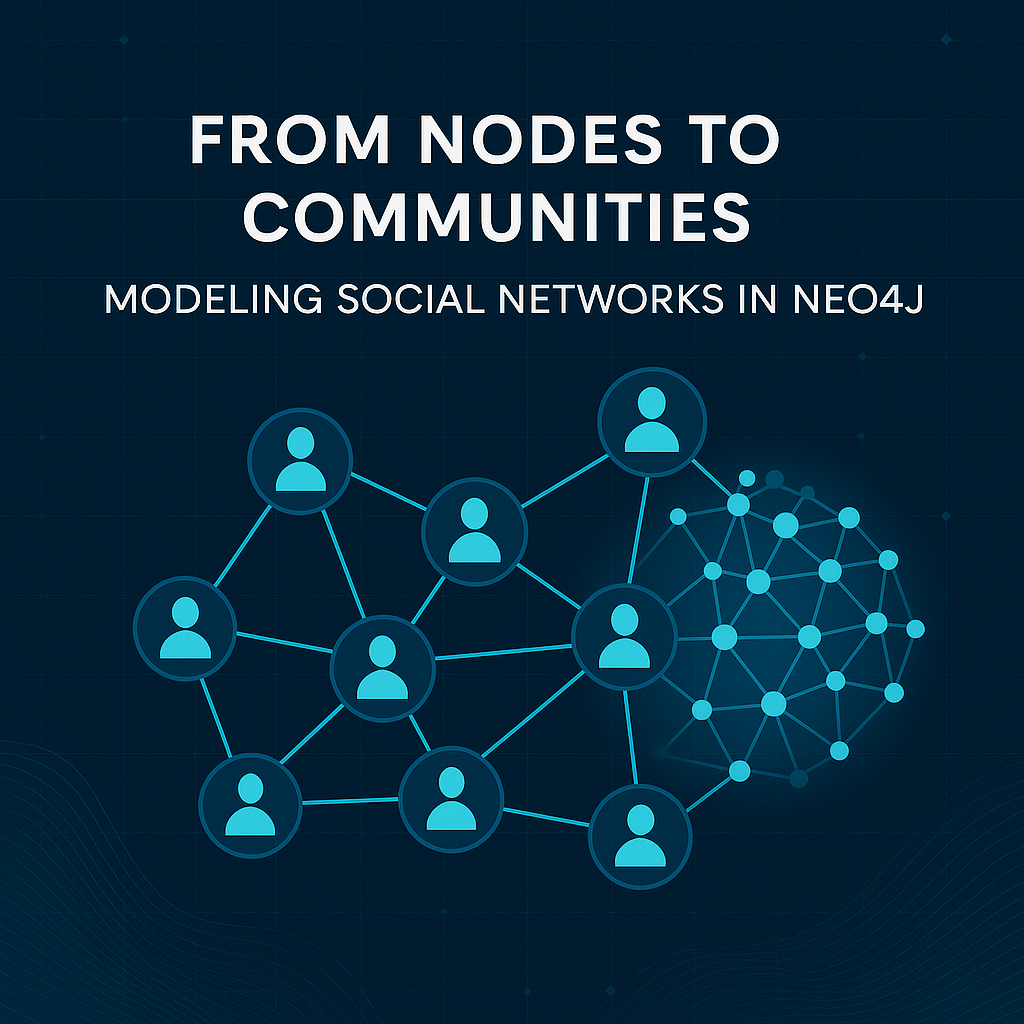
Modeling Social Networks in Neo4j: From Nodes to Communities Explained
Introduction
As social networks become more central to how we communicate, analyze trends, and understand human behavior, the way we store and model those relationships is evolving. Traditional relational databases often struggle with the complexity of interconnected data. That’s where graph databases like Neo4j come in.
The power of modeling social networks in Neo4j lies in its ability to represent relationships as first-class citizens—making it easier to detect communities, influencers, and hidden patterns. Whether you’re building a social app, analyzing followers, or mapping a professional network, graph-based modeling provides unmatched flexibility and performance.
Why Use Neo4j for Social Network Modeling?
Neo4j is a native graph database designed to handle highly connected data. Unlike relational databases that require complex joins, Neo4j connects data through nodes and relationships—ideal for social graphs.
Key Advantages:
-
Natural representation of social structures
-
High performance on complex relationship queries
-
Powerful community detection algorithms
-
Real-time graph traversal
Basic Building Blocks: Nodes, Relationships, and Properties
In Neo4j, social networks are modeled using:
-
Nodes: Represent people, groups, posts, etc.
Example:(Person {name: 'Alice'}) -
Relationships: Define how nodes are connected.
Example:(Alice)-[:FRIEND]->(Bob) -
Properties: Store additional info like age, timestamp, or type.
Example:{since: '2021-01-01'}
This makes queries intuitive and scalable—perfect for modeling large, dynamic networks.
Use Case: A Simple Friendship Network
Let’s model a basic friendship network:
This small graph already enables you to:
-
Find mutual friends
-
Detect loops
-
Track indirect relationships
From Nodes to Communities: Using Graph Algorithms
One of Neo4j’s superpowers is its Graph Data Science Library, which includes powerful algorithms like:
Community Detection Algorithms
-
Louvain Modularity
-
Label Propagation
-
Weakly Connected Components
These help detect clusters of users who interact more frequently—valuable for:
-
Marketing segmentation
-
Influencer targeting
-
Recommender systems
Want to go deeper? Explore Neo4j’s official Graph Data Science docs.
Query Example: Finding Influencers
You can find high-importance nodes using PageRank:
This reveals which users are most “influential” based on how well-connected they are in the network.
Best Practices for Modeling Social Networks in Neo4j
-
Use directional relationships when the interaction isn’t mutual (e.g., follows vs. friends).
-
Add timestamps and weights to relationships for historical analysis.
-
Normalize user behavior into types:
LIKES,COMMENTS,FOLLOWS, etc. -
Index properties that are often queried (e.g.,
email,username).
Scaling Your Graph for Real-World Applications
As your network grows, so does the complexity. Consider:
-
Using Neo4j Aura (cloud-managed service)
-
Integrating with Apache Kafka for real-time updates
-
Exporting results into dashboards using Bloom or GraphXR